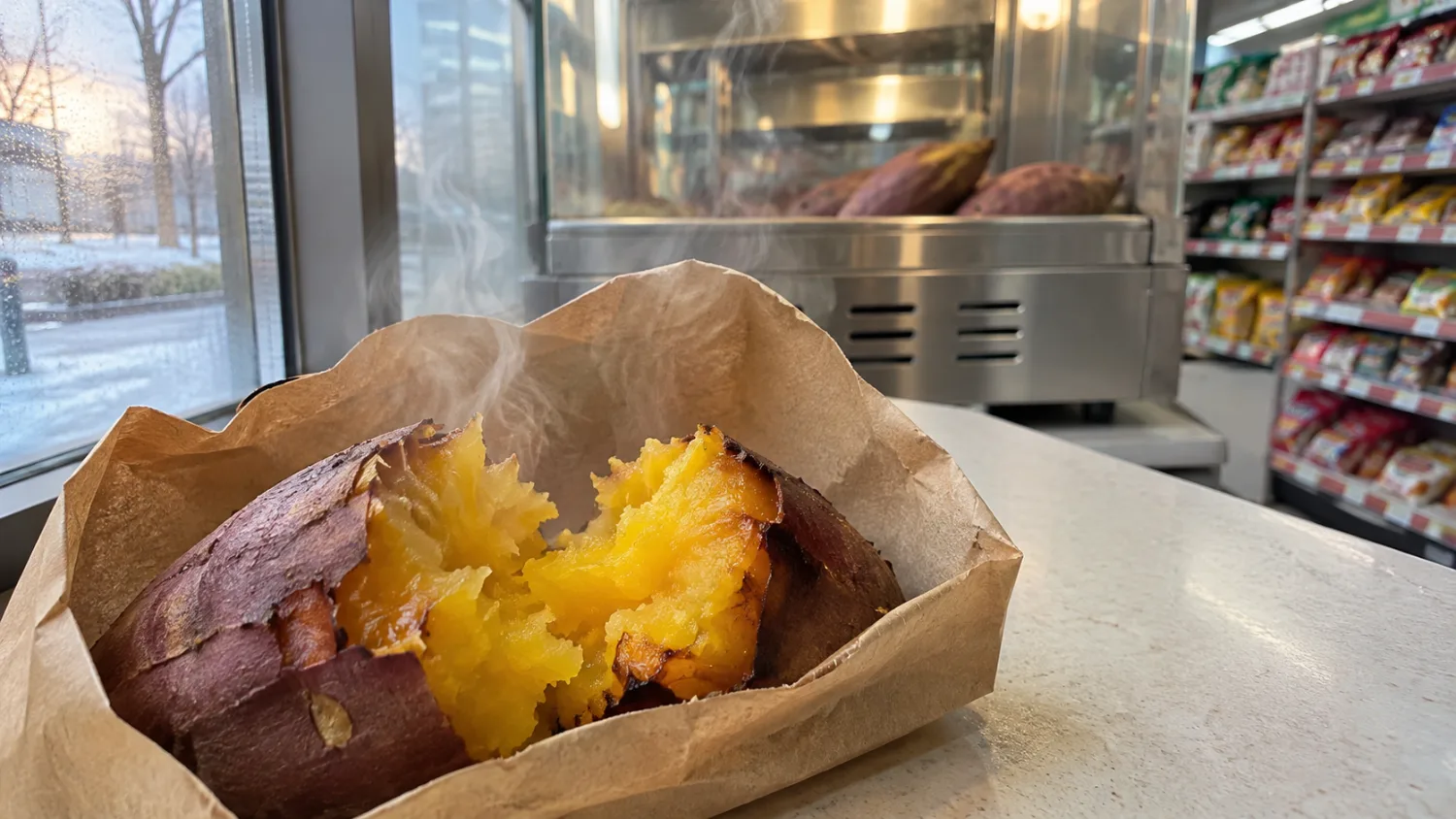
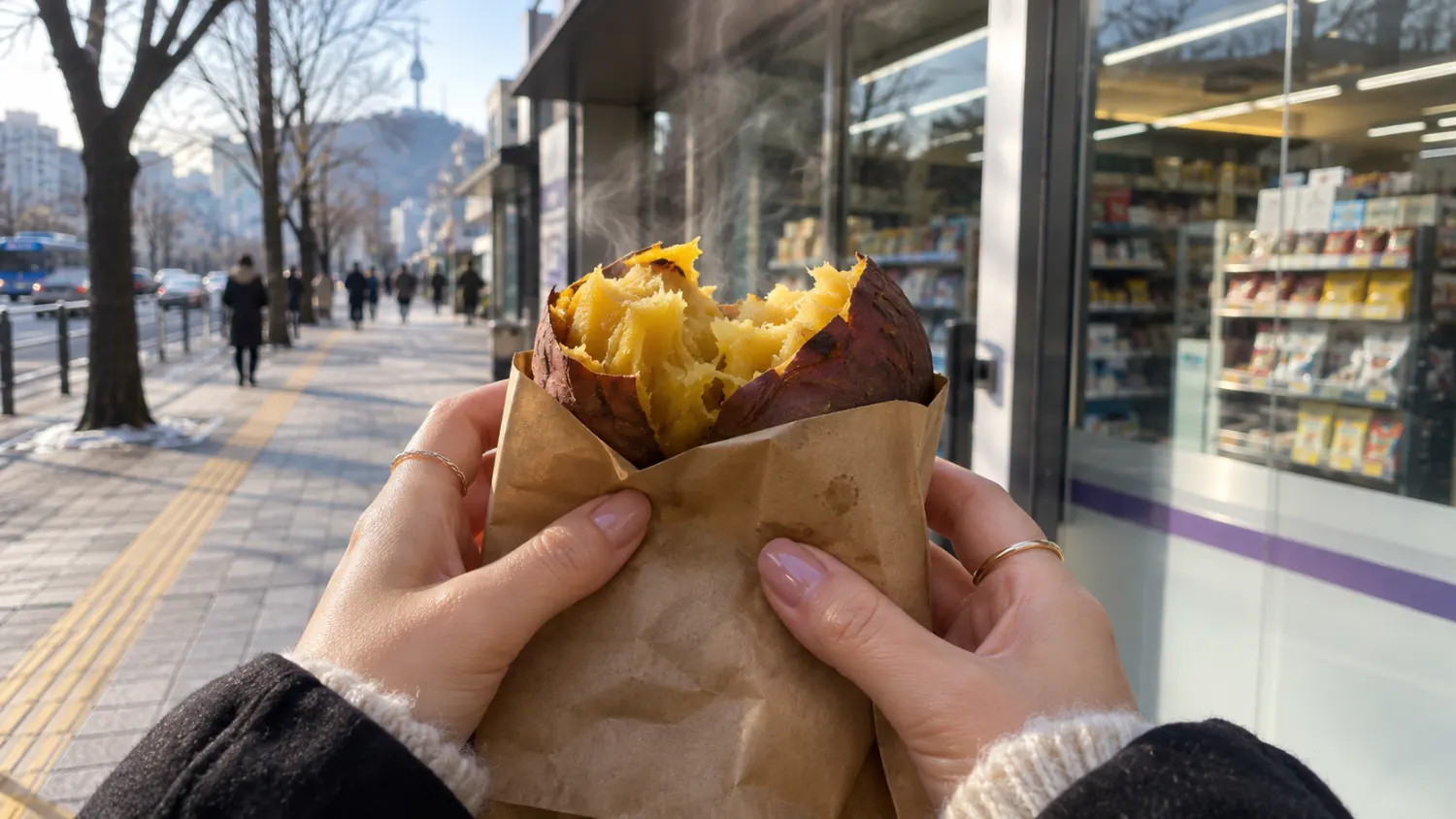
Walk into a Korean convenience store on a cold morning and you may notice a warm, caramel-like smell before you see the source. It often comes from gungoguma (군고구마), whole sweet potatoes slowly roasted until the skin wrinkles and the center turns soft and sweet.
Korean convenience store roasted sweet potatoes are an easy first snack for travelers. They are not spicy, require no complicated preparation, and work as either a light breakfast or a warm snack between sightseeing stops. Availability changes by store and season, but interest among international visitors is growing quickly.
In This Article
Why Roasted Sweet Potatoes Are a Korean Winter Favorite
Roasted sweet potato has long been associated with cold weather in Korea. The Korean government’s Korea.net winter snack guide describes gungoguma as a common winter food found at street stalls, convenience stores, and homes. The appeal is simple: it is warm enough to hold on a cold day, naturally sweet, and easy to eat without utensils.
The timing also follows Korea’s harvest and distribution cycle. Korea Agro-Fisheries & Food Trade Corporation data show that open-field sweet potatoes are generally harvested from late summer through late October, with the main market season running from November into January. That helps explain why roasting machines and hot sweet potatoes become easier to spot as autumn turns into winter.
They are becoming especially visible to travelers. According to a November 2026 Seoul Economic Daily report, CU’s roasted sweet potato sales to foreign customers increased 115.6% year over year from January through October. GS25 recorded a 171.4% increase through September. GS25 also said foreign-customer purchases of winter snacks were highest in the morning, suggesting that visitors are treating them as a quick breakfast as well as a snack.
How to Find and Buy One at a Convenience Store
Start by looking near the front counter or hot-food area. Some stores use a compact roasting cabinet or heated display, while others place sweet potatoes in a warmer with paper bags and tongs nearby. Store layouts are not standardized, so the setup can look different even within the same chain.
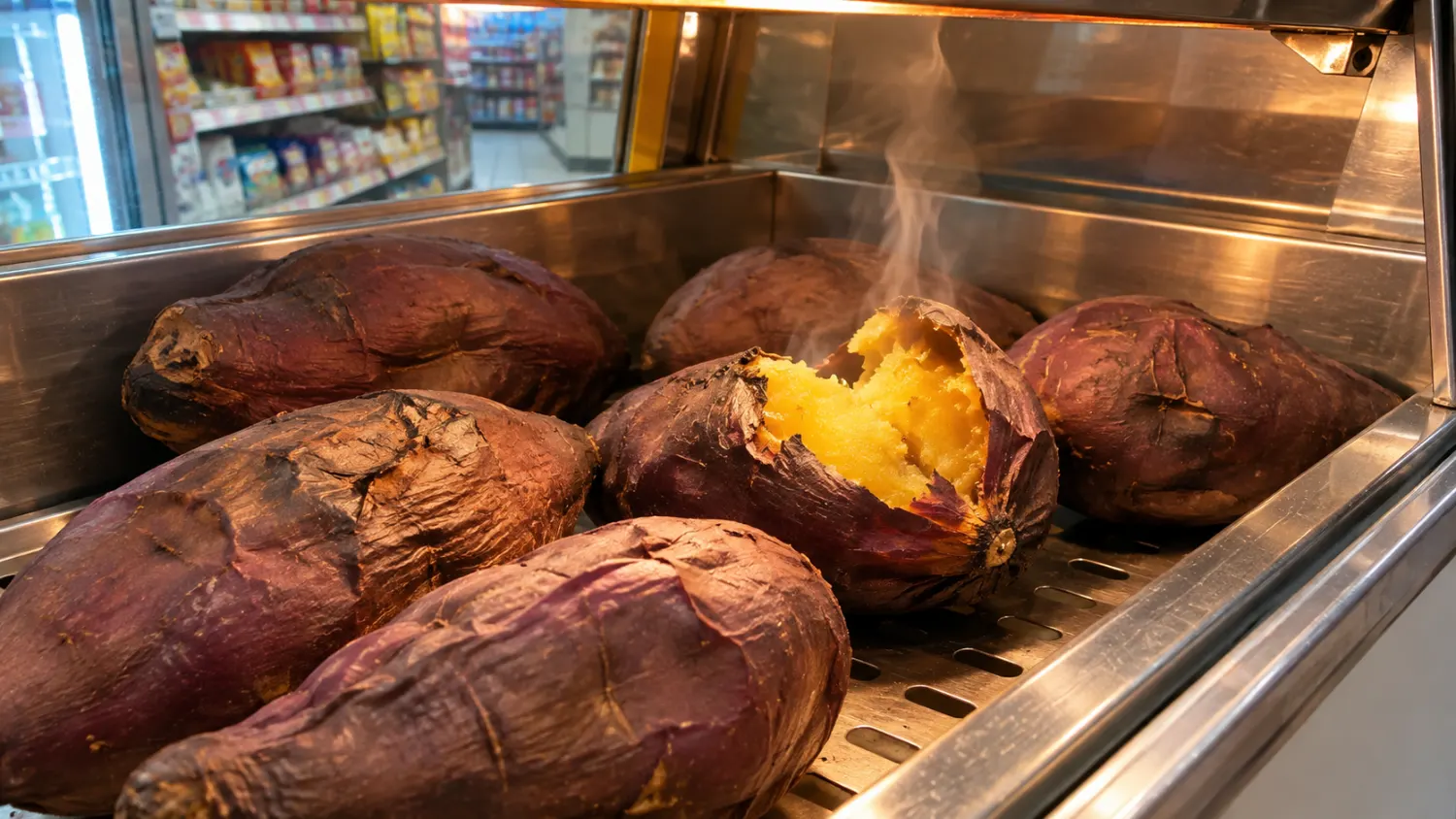
If you cannot see them, ask a staff member, “Gungoguma isseoyo?” (군고구마 있어요?), which means “Do you have roasted sweet potatoes?” A branch may be sold out, may not operate a roaster, or may offer them only during colder months. Do not make a special trip based only on a social media video without checking the store or chain app first.
- Look for: a heated cabinet, roasting machine, paper bags, or a sign containing 군고구마.
- Choose carefully: select one with intact skin and no leaking, heavily damaged, or burnt sections.
- Use the provided tool: use tongs if they are available rather than handling several potatoes with your hands.
- Take it to the register: the cashier will confirm the current price and any applicable promotion.
- Let it cool briefly: the center can stay much hotter than the skin suggests.
Roasted sweet potatoes have also entered Korea’s quick-commerce market. GS25 began offering them through delivery services in 2026, while CU reported year-over-year growth in delivered roasted sweet potato sales. For most travelers, buying one directly is the better experience because you can check that it is still hot and eat it immediately.
What Will a Korean Roasted Sweet Potato Taste Like?
The texture can vary more than first-time buyers expect. Korea grows several types of sweet potato, and stores may change suppliers or varieties without much English information. The product label may not identify the exact cultivar, but three common Korean descriptions can help you understand what you are eating.
| Common Korean term | Typical texture | What to expect |
|---|---|---|
| Bam-goguma 밤고구마 | Drier and fluffy | A chestnut-like texture that can feel dense and filling |
| Hobak-goguma 호박고구마 | Soft and moist | A smoother center with a deep yellow or orange color |
| Kkul-goguma 꿀고구마 | Moist and very sweet | Often develops a syrupy surface after roasting and proper curing |
The names describe eating qualities rather than guaranteeing one exact flavor. A small sweet potato may be firm and lightly sweet, while a larger, well-roasted one may have a sticky, almost custard-like center. Korea’s Rural Development Administration has also reported that roasting can produce a sweeter result than steaming in tested Korean varieties.
You can eat the skin if it is clean and you enjoy the chewy texture, but many people simply split the potato and peel back the skin as they go. No sauce is needed. A plain roasted sweet potato pairs well with water, unsweetened coffee, or milk if you want a more substantial breakfast.
Practical Tips for Travelers
Buy one when you are ready to eat it rather than carrying it around all day. Open the bag carefully and break the potato in half to release steam. The inside can be extremely hot, especially near the center, so take a small first bite.
Plain roasted sweet potato is usually a single-ingredient food, but a convenience store is still a shared retail and food-handling environment. If you have a serious food allergy, do not assume the tongs, warmer, or nearby preparation area is free from cross-contact. Ask the staff if you need specific information, and skip the item if the handling setup is unclear.
If you save part of it, cool and refrigerate it promptly rather than leaving it in a backpack or hotel room for hours. The USDA leftovers guidance recommends refrigerating cooked leftovers within two hours. Reheat it only when you have suitable storage and heating facilities.
Most importantly, treat availability as part of the hunt. Roasted sweet potatoes are seasonal, individual stores can sell out, and the variety may change. That unpredictability is also part of the appeal: it is a simple way to experience an everyday Korean winter food rather than a snack designed only for tourists.
Frequently Asked Questions
What is roasted sweet potato called in Korean?
It is called gungoguma (군고구마). You can ask “Gungoguma isseoyo?” if you want to know whether a convenience store currently has it.
Can I find roasted sweet potatoes at every CU or GS25?
No. Availability depends on the branch, season, equipment, and remaining stock. They are easier to find during colder months, but checking a nearby store is more reliable than assuming every location sells them.
Is a Korean roasted sweet potato spicy or heavily seasoned?
Usually not. It is generally sold plain, with its sweetness coming from the sweet potato and roasting process. Travelers with severe allergies should still ask about handling and possible cross-contact in the store.